
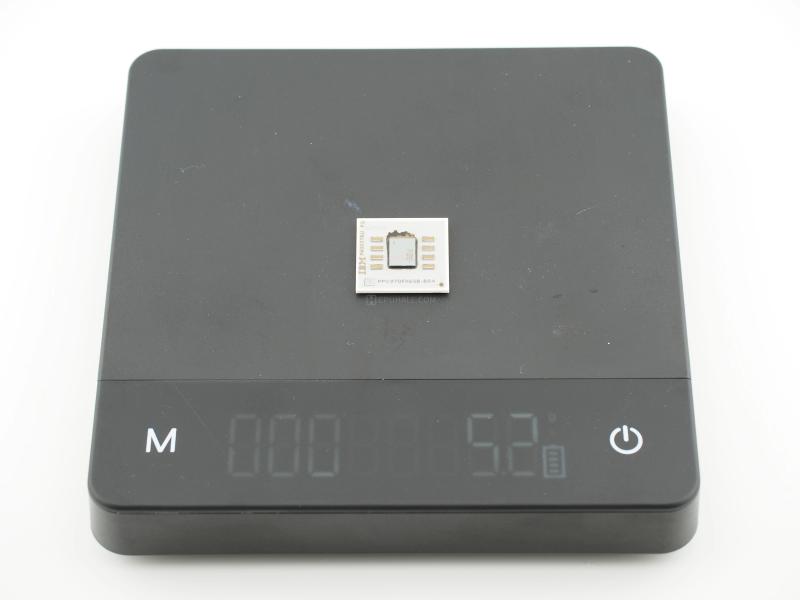
The chip weighs in at exactly 5.2 grams, which feels substantial for a package measuring roughly 21mm squared.
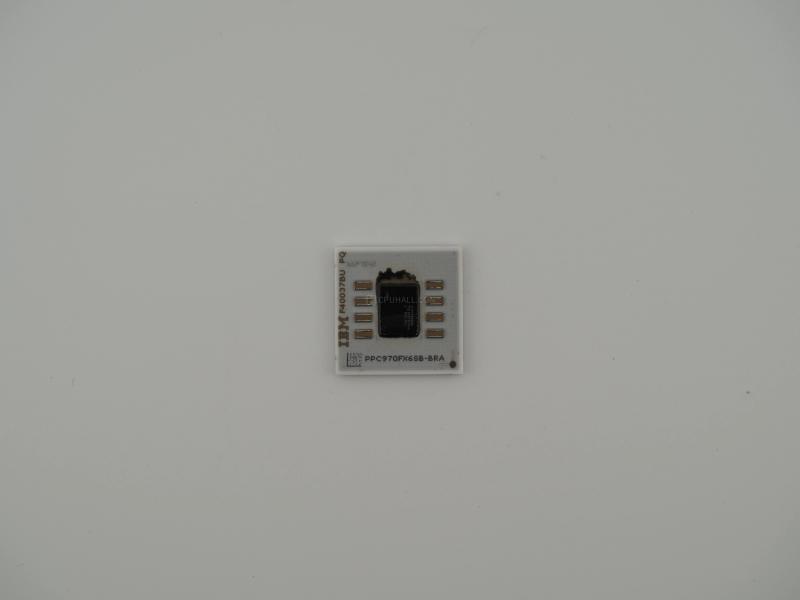
The physical condition is fascinating. The exposed flip-chip die has a remarkably glossy, mirror-like finish that reflects a lot of light, but it is surrounded by a rather messy, dark underfill epoxy that has cured unevenly around the edges. Flanking the die are eight gold-plated surface-mount capacitors. The ceramic itself has a very fine, slightly porous texture that catches the light perfectly, and flipping it over reveals a pristine, high-density ball grid array ready for mounting.
I was able to transcribe the faint laser etchings across both the ceramic and the die itself.
Ceramic Substrate (Left side, vertical):IBM F40037BU PQ
Ceramic Substrate (Top edge, dotted matrix):66P7842
Ceramic Substrate (Bottom edge):PPC970FX6SB-BRA
Silicon Die (Center):1FR4T00000
75E2K070S066
L 028-021
Silicon Die (Bottom Left):IBM
Here we have the beating heart of an era defining machine. The PowerPC 970FX is the 90 nanometer die shrink of the original 130 nanometer PowerPC 970. IBM engineered this silicon using their advanced Silicon on Insulator fabrication process, which was crucial for reducing current leakage at higher clock speeds.
Packing roughly 58 million transistors, this architecture is a beast of a superscalar processor. It features dual double-precision floating-point units and a highly advanced SIMD execution unit that Apple famously marketed as the "Velocity Engine" (officially known as AltiVec or VMX). The pipeline was lengthened significantly compared to the older PowerPC G4, allowing for much higher raw frequencies but requiring aggressive branch prediction to keep the execution units fed.
Thermal dissipation was the defining engineering challenge of this chip. The messy underfill visible on this artifact is a testament to the thermal cycling stress these packages endured. The 970 and 970FX ran incredibly hot. They drew massive amounts of current for the era, requiring robust power delivery and creating a thermal density nightmare for system designers trying to cool a tiny piece of exposed silicon.
This artifact represents the glorious, fiery twilight of the Apple and IBM alliance. Known to the public as the "PowerPC G5", this architecture was famously introduced by Steve Jobs in 2003 with the promise that it would hit 3.0 GHz within a year. That promise became one of the most legendary broken targets in tech history.
IBM simply could not scale the 90nm process fast enough while keeping the thermal envelope manageable. The G5 hit a brutal thermal wall. It ran so hot that Apple was forced to develop a complex, highly leak-prone liquid cooling system just to keep the top-tier dual-processor Power Mac G5 workstations from melting down.
The most persistent myth of this era was the highly anticipated "PowerBook G5". Enthusiasts waited years for Apple to put this chip into a laptop. I vividly remember the forum rumors claiming it was just around the corner. In reality, the 970FX simply drew too much power and expelled too much heat to ever survive inside a thin aluminum chassis. This thermal failure is the exact reason Apple ultimately abandoned the PowerPC architecture entirely and transitioned to Intel processors in 2006.
Identifying this piece is straightforward thanks to the clear "PPC970FX" branding on the substrate, but pinning down its exact original host system requires some deductive reasoning.
The PPC970FX6SB-BRA part number confirms it is the 90nm revision. The 66P7842 printed at the top strongly resembles an IBM FRU (Field Replaceable Unit) part number, which is very typical for components allocated for IBM's own enterprise hardware. While the PowerPC G5 is most famous for its use in Apple's Power Mac and iMac lines, IBM also utilized these chips extensively in their BladeCenter JS20 blade servers.
Given the BGA format (meaning it was soldered directly to a logic board rather than socketed) and the specific IBM formatting of the serial numbers, I am highly confident this specific chip was harvested from either a logic board of an Apple iMac G5 or an IBM BladeCenter unit. The lack of an integrated heat spreader, which was sometimes present on desktop-class chips, points heavily toward a system with a direct-die cooling mechanism. It is a fantastic, raw example of mid-2000s supercomputing silicon scaled down for the desktop.