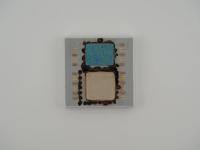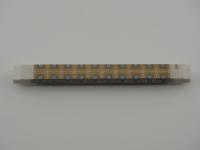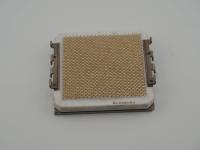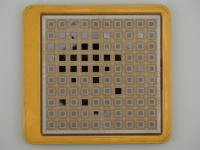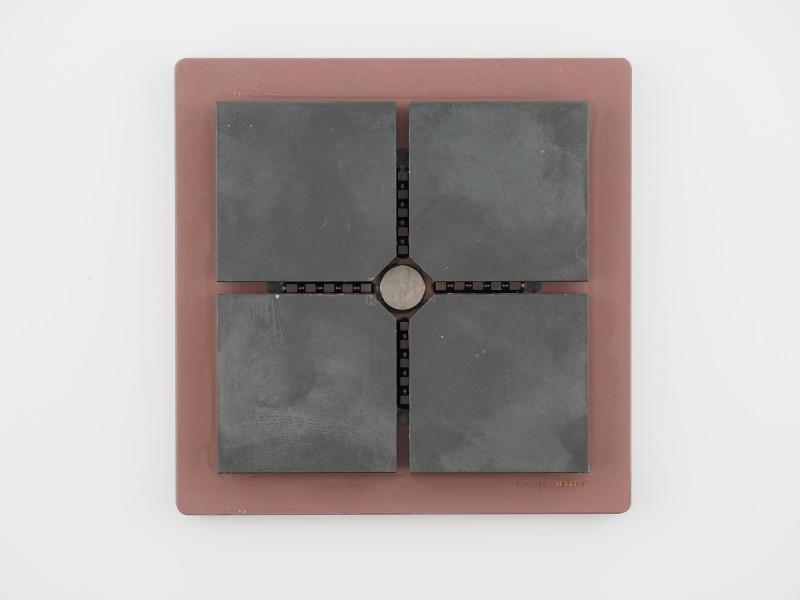

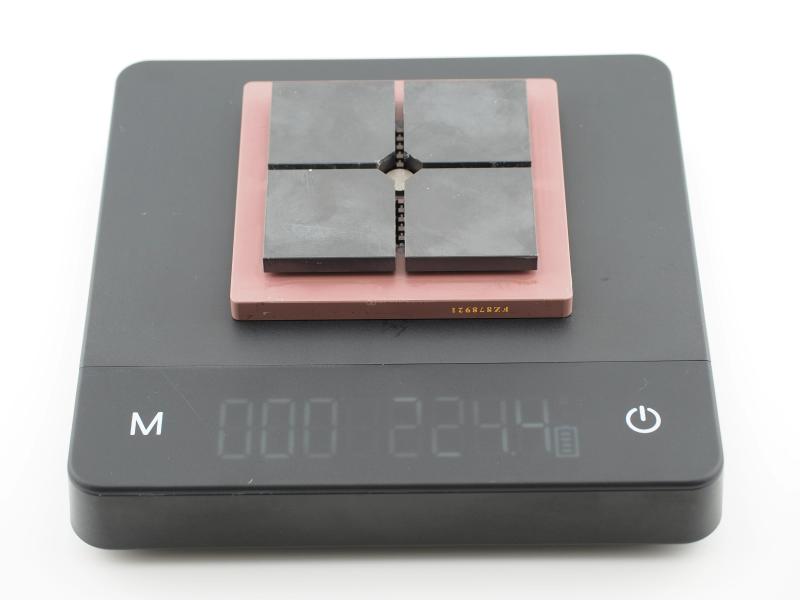
Holding this piece, the sheer density is the first thing that strikes you. Tossing the entire assembly onto the scale registers a massive 1.852 KG, with the naked ceramic substrate and dies making up 224.4 grams of that total. It is a terrifyingly beautiful chunk of heavy metal and silicon. Framing this up under my 45mm Elmarit macro lens, the micro-contrast on the ceramic substrate really pops, revealing the gorgeous, almost crimson-brown tone of the material.
Here is the exact visual forensic data pulled from the surfaces:
Carrier Label:(11S)PN SN: 44P4719 Z783016
EC: H12925
2003-11-16
Assembled in the US of US and Non-US Components
(4L)Origin: US
Metal Frame Etching:A 24482 17 433-8447D
Ceramic Edge 1 (Gold Print):FZ878921
Ceramic Edge 2 (Faint Dot-Matrix):LLF2214 80P1976
The gold pin arrays are divided into four distinct quadrants on the bottom, flawlessly aligning with the four massive silicon dies on top. The metal carrier is an absolute unit of engineering. It features thick steel construction, precision-machined threaded holes for the cooler mounting, and gorgeous brazed copper inserts around the mounting points. There is some minor surface wear and scratching on the metal carrier frame, but the pins and dies are in pristine, museum-grade condition.
This artifact represents a pinnacle of early 2000s server engineering. The POWER4 was famously the first microprocessor to incorporate two cores onto a single die. With four dies densely packed onto this Multi-Chip Module (MCM), we are looking at an 8-core powerhouse. The engineering required to make this function was staggering. IBM had to design a custom ceramic substrate capable of routing the immense amount of bandwidth required for these four dies to communicate with each other and the massive external L3 cache that would sit alongside this module on the system board.
The thermal challenges were monumental. Getting the heat out of four tightly packed dies required the heavy metallic carrier you see surrounding the ceramic. The bare dies would interface directly with a massive copper cold plate or heatsink, clamped down with intense mounting pressure via those threaded copper-brazed holes. The fabrication node was cutting-edge for its era, utilizing IBM's advanced Silicon-on-Insulator (SOI) technology and copper interconnects to push clockspeeds well past the gigahertz barrier while keeping power leakage somewhat manageable.
The POWER4 architecture is legendary. When IBM dropped the p690 "Regatta" series UNIX servers, they absolutely decimated the competition from Sun Microsystems and HP. It was a complete paradigm shift. While the rest of the industry was still trying to scale up single-core performance, IBM just decided to brute-force the issue by throwing multiple cores on a die and then cramming four of those dies onto a single ceramic plate.
There is a running joke among vintage hardware collectors that IBM's design philosophy during this era was simply "make it heavier." And honestly, looking at this artifact, it is hard to argue. The sheer hubris of this packaging is what makes it so desirable today. Many of these modules met a sad fate in the scrap yards, shredded and chemically melted down just to recover the gold from the thousands of pins on the bottom. Finding one intact, let alone with its original mounting carrier and clean dies, is a rare treat.
Based on the four-die layout, the distinctive dark ceramic, and the heavy metal carrier, I am highly confident in identifying this as an IBM POWER4 MCM. The date code on the label clearly reads November 16, 2003, which places it perfectly in the active lifecycle of the POWER4 and POWER4+ generation of enterprise servers.
The part number 44P4719 aligns with IBM FRU (Field Replaceable Unit) codes from the pSeries era. While the later POWER5 modules incorporated both processor dies and L3 cache dies onto the same MCM resulting in eight rectangular chips on the substrate, the distinct four large, square dies present here perfectly match the physical topology of the POWER4. The visual evidence leaves almost zero room for doubt. It is a textbook example of IBM's early multi-core server supremacy.