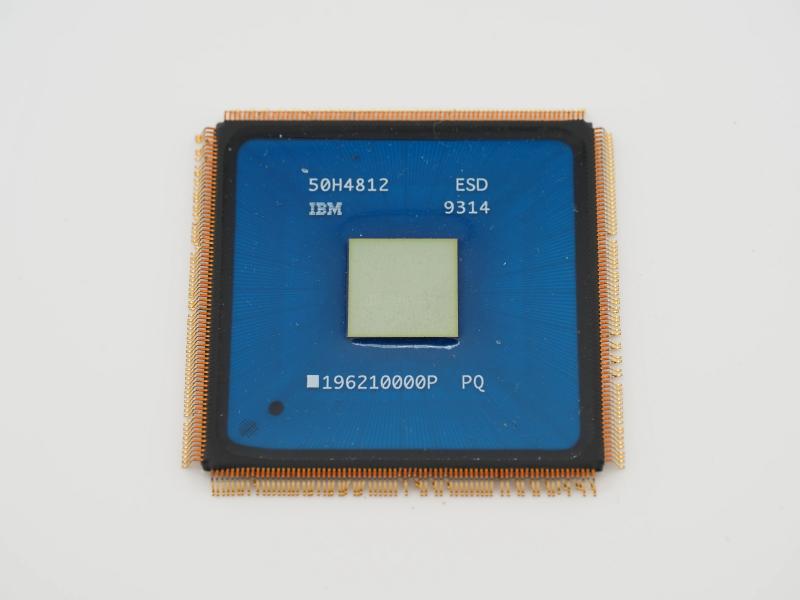

The micro-contrast captures a distinct radial sunburst pattern embedded beneath the glossy blue surface of the cap.
The surface text is pristine and reveals the following identifiers:
50H4812         ESD
IBM             9314
[Square Logo] 196210000P   PQ
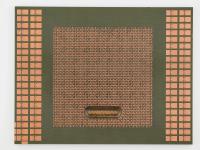
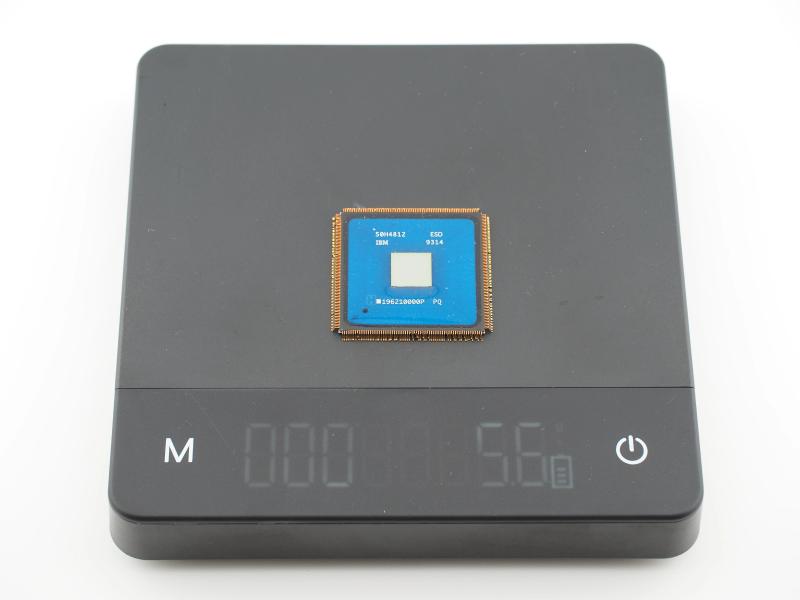
The gold gull-wing pins of this CQFP package are brazed flawlessly to the bright white ceramic substrate. You can clearly see the bead of clear epoxy or glass sealant running along the perimeter of the blue cap, binding it permanently to the ceramic base. Flipping this artifact over reveals a completely bare, pristine white ceramic bottom with four small circular alignment marks in the corners. It is a brilliant example of early 1990s IBM fabrication aesthetics.
This is a weird and wonderful piece of silicon. Beneath that blue, sunburst-patterned cap lies an IBM Internal Microprogrammed Interface processor. We are talking about a 48-bit CISC architecture. In an era when most of the world was standardizing on 32-bit computing or pushing toward 64-bit RISC, IBM was running this unique 48-bit instruction set specifically tailored for the AS/400 family.
The engineering of the AS/400 processors was entirely dictated by their operating system and abstraction layer. The hardware did not need to run standard code; it only needed to execute instructions from the Technology Independent Machine Interface. This meant the silicon could be highly specialized. The CQFP packaging provided excellent thermal characteristics for the era, allowing the heat from the die to spread across the metallic cap while the ceramic substrate offered rigid stability for the surface-mount pins.
The AS/400 is the stuff of enterprise legend. These systems are famous for their mythical uptime. There are literal urban legends of companies accidentally walling up an AS/400 system behind drywall during a renovation, only to realize the machine kept quietly running their database for years without human intervention.
The real magic of the AS/400 and its IMPI architecture was the abstraction layer. Because software talked to the virtual machine interface rather than the bare metal, IBM pulled off one of the greatest architectural heists in computing history. They seamlessly transitioned the entire AS/400 line from this weird 48-bit CISC silicon to 64-bit PowerPC RISC processors in the mid-1990s, and none of the software broke. The transition was completely transparent to the end-users. It was such an impenetrable, reliable fortress of a system that Bill Gates famously remarked in 1993 that the AS/400 division was the only part of IBM that Microsoft would actually want.
I am highly confident in identifying this as a primary CPU or major processor complex chip from an early 1990s IBM AS/400 system. The 9314 date code firmly places its manufacturing in the 14th week of 1993. This aligns perfectly with the rollout of the AS/400 F-Series and early Advanced Series systems.
Furthermore, the physical characteristics are a dead giveaway. The striking blue cap with the white ceramic base and the "PQ" designation directly match known teardowns of AS/400 CPU boards from that exact era. While specific part numbers like 50H4812 and 196210000P are often lost to time or buried in proprietary IBM service manuals, the visual evidence is undeniable. The "9314PQ" code itself has been noted by other collectors as a core identifier for these specific IBM CPU complexes. It is a fantastic artifact from the golden age of IBM midrange mainframes.