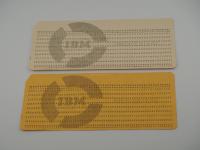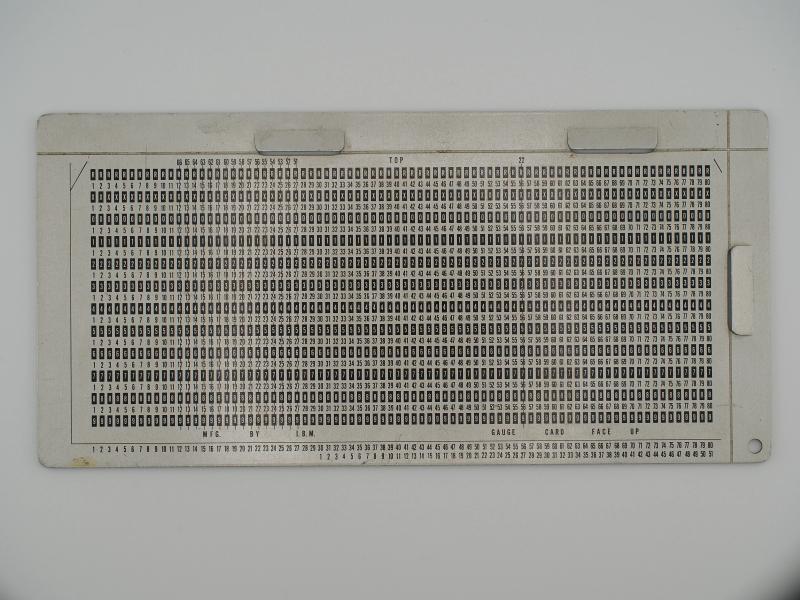

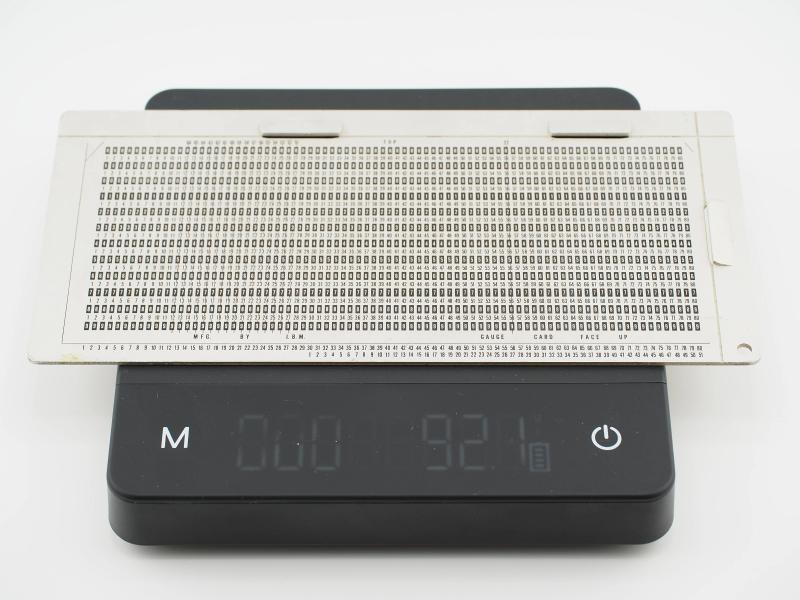
While my collection is predominantly focused on the exotic silicon and ceramic of the digital age, occasionally a piece of pure, cold-war-era mechanical computing history demands inclusion. Holding this specific artifact, an IBM card registration gauge, I am immediately struck by the tactile reality of early data processing. Weighing exactly 92.1 grams on the scale, this is a stamped, rigid metal template designed for the harsh daily environment of a mainframe keypunch room.
The front face features a dense, printed matrix mapping out the legendary 80 columns and 12 rows of the standard IBM punch card format. I can clearly read the crisp, utilitarian typography printed along the bottom edge:
MFG. BY I. B. M. GAUGE CARD FACE UP
Along the top and right edges, the metal has been precisely folded to create raised guides. The patina is fantastic. There is a slight yellowing and minor rust spotting on the bottom left corner, speaking to decades of handling by operators. Flipping the gauge over reveals the true treasure. A perfectly preserved, though heavily aged and browned, adhesive paper label provides the strict daily operational directive for the facility:
THE REGISTRATION OF ALL CARD PUNCHING EQUIPMENT SHOULD BE CHECKED ONCE
EACH DAY. THIS GAUGE SHOULD BE USED TO CHECK THE REGISTRATION OF ALL KEY
PUNCHES, REPRODUCING PUNCHES, AND CALCULATING PUNCHES.
TO USE THIS GAUGE, PUNCH A TEST CARD WITH 12-9 DIAGONALLY ACROSS 80 COLUMNS
AND PLACE THE CARD FACE UP 12 EDGE TO THE TOP FIRMLY AGAINST THE GUIDES
AT TOP AND RIGHT HAND END.
ANY MACHINES OUT OF REGISTRATION SHOULD BE REPORTED TO YOUR SUPERVISOR
IMMEDIATELY.
Before we had parity bits, ECC memory, and CRC checks, data integrity was a fundamentally mechanical problem. This gauge represents the physical manifestation of error checking. IBM's 80-column card format used rectangular holes, and the tolerances for reading these cards at high speed were incredibly tight.
If a keypunch machine, such as the legendary IBM 029, drifted out of physical alignment due to mechanical wear, the holes would be punched slightly off-center. When that card was subsequently fed into a high-speed reader attached to an IBM System/360 mainframe, the mechanical sensing brushes or early optical sensors might miss the hole entirely, or worse, read a single punch as two adjacent data points. This simple metal template was the absolute baseline for data fidelity. The operator would slide the test card against the metal guides and visually verify that the physical holes aligned perfectly with the printed grid underneath. It is hardware debugging in its most literal, analog form.
The 80-column card was the lifeblood of the 20th century. It processed the Apollo missions, handled the global financial system, and tracked the logistics of the Cold War. The phrase do not fold, spindle, or mutilate entered the cultural lexicon because of the physical fragility of this data medium.
What I love about this gauge is the aggressive corporate tone of the instruction label. Checked once each day. Reported to your supervisor immediately. It paints a vivid picture of the sheer discipline required to keep early computing centers operational. There is a myth that computing was somehow more reliable before modern operating systems. The reality, proven by this gauge, is that reliability was bought with relentless, daily human intervention and strict mechanical calibration. Without tools like this, the mighty mainframes of the era would have been fed nothing but garbage data.
Identifying this piece is straightforward thanks to the explicit labeling, but dating it requires a bit of an educated guess based on materials and typography. The use of the adhesive paper label with that specific sans-serif typeface heavily suggests the 1950s or 1960s.
During this era, IBM completely dominated the data processing market. Every major corporate and government computing facility running IBM hardware would have had these exact gauges sitting next to their keypunch stations. While millions of punch cards were thrown away, tools like this were often kept by engineers and operators as keepsakes when facilities eventually transitioned to magnetic tape and disk storage. It is a brilliant, tangible reminder that before we pushed electrons through microscopic gates in silicon, we punched physical holes in paper to change the world.