
It might seem almost heretical to include paper artifacts in a museum dedicated to ceramic, gold, and exotic silicon. But holding these two pristine, unpunched data cards in my hands, I am struck by the absolute mechanical precision required to make the earliest mainframes function. These are the ancestors of every TCM, every silicon wafer, and every modern SSD.
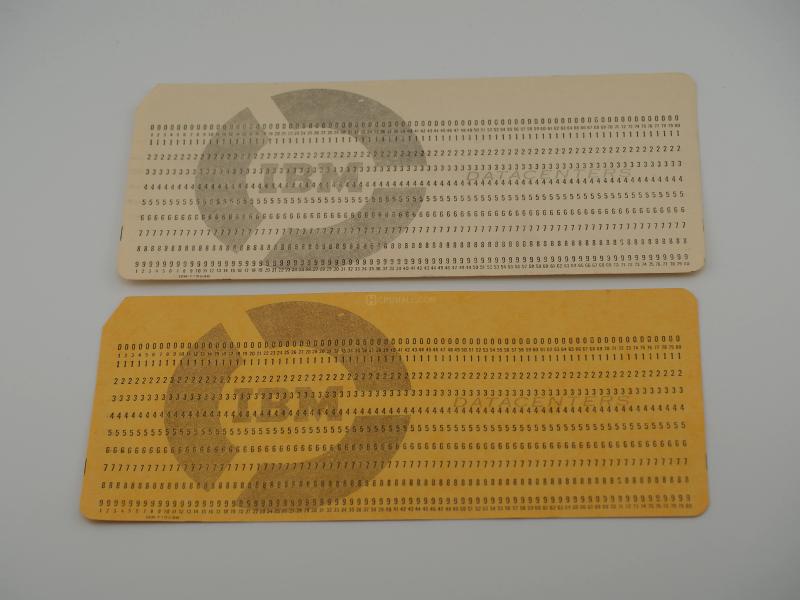
Here we have two beautifully preserved IBM 80-column punched cards, specifically form F19936. Observing these specific artifacts, the contrast in material is immediately striking. The top unit is cut from classic, pale cream manila stock, while the bottom card is a vibrant, aggressive dark yellow or orange. Despite the color difference, they share identical, highly detailed surface printing.
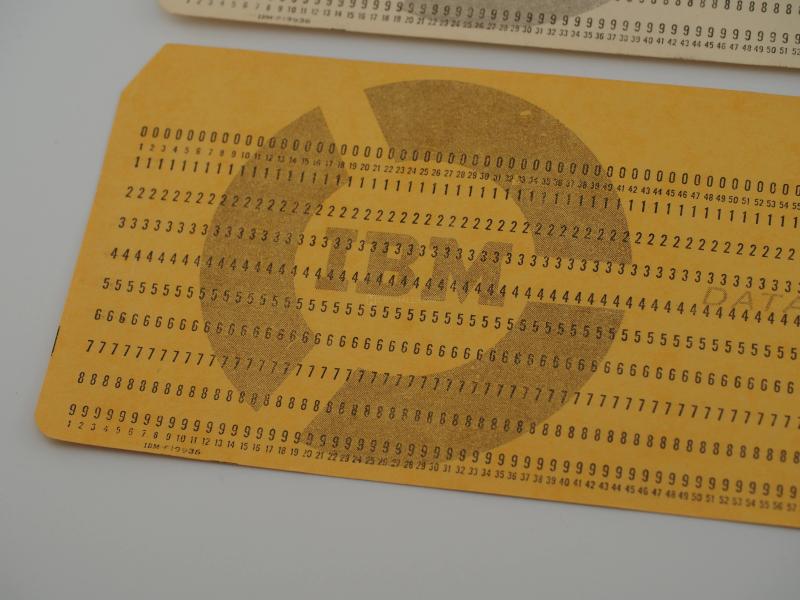
A massive, halftone-style grey IBM globe logo dominates the left-center of the cards, serving as an anti-counterfeit watermark of sorts. Printed horizontally across rows 3 and 4 on the right side is the word DATACENTERS, rendered in a fascinating, stylized outline font that mimics dot-matrix printing. Looking closely at the very bottom left corner, just below the column index numbers, the manufacturer part number is clearly visible in a microscopic serif font:
IBM F19936
The texture of the card stock is notably stiff and entirely smooth. There is zero fraying on the corners. They smell faintly of old libraries and machine oil. These are blank canvases of computing history.
To understand the engineering of a punch card, you have to stop thinking about electrons and start thinking about high-speed mechanical physics. This was physical memory. Each card measures exactly 7.375 inches by 3.25 inches. The true engineering marvel, however, was the thickness. IBM strictly mandated a thickness of 0.007 inches.
Why was this tolerance so tight? Because mainframe card readers, like the legendary IBM 1402, processed these cards at speeds of up to 800 cards per minute. If a card was a fraction of an inch too thick, it would jam the high-speed pneumatic rollers. If it was too thin, it would tear under the immense physical stress of the reader's metal brushes .
Each card holds 80 columns of data. A single rectangular hole punched in a specific column and row represented a single character, translating to a maximum storage capacity of exactly 80 bytes per card. Programming in this era meant carrying your code in heavy cardboard boxes. A simple operating system update could weigh forty pounds.
You cannot discuss vintage IBM hardware without mentioning the most famous computing mantra of the 20th century: "Do not fold, spindle, or mutilate."
This phrase was printed on millions of IBM cards distributed to the public for utility bills, government checks, and university registrations. It was a stern warning that these cards were not just paper; they were machine-readable memory. A stray fold or a tear from a desk spindle would completely crash the sorting machines.
A common myth in the hardware community is that the size of the IBM punch card was based on the size of the US dollar bill. While it is a fun story, it is largely apocryphal. The dimensions were chosen by Herman Hollerith in the late 19th century to fit standard storage cabinets of the era. The format survived for nearly a century before magnetic tape and spinning disk drives finally rendered paper memory obsolete in the late 1970s.
When I acquired this specific pair of F19936 cards, the primary mystery was the massive "DATACENTERS" overprint. IBM produced thousands of custom card layouts for specific clients like banks, universities, and government military branches.
The presence of the generic "DATACENTERS" branding strongly indicates these were intended for use within IBM's own Service Bureau Corporation or similar generic data processing facilities. Businesses that could not afford to purchase a million-dollar System/360 would rent computing time at an IBM Datacenter. These cards were likely bulk stock provided to customers to keypunch their data off-site before bringing boxes of these cards into the datacenter for processing.
The fact that these survived completely unpunched is a minor miracle. Usually, blank cards were either used up or thrown into the incinerator when a datacenter transitioned to magnetic tape. Finding them in this condition, with the ink still crisp and the corners perfectly sharp, is a fantastic addition to the archive.