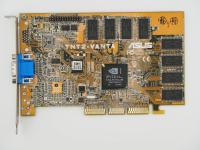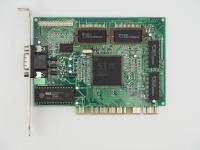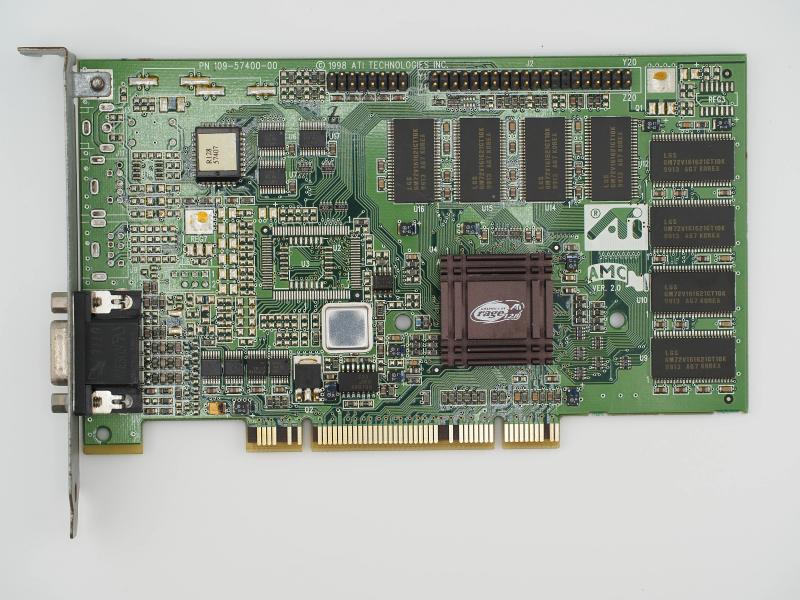

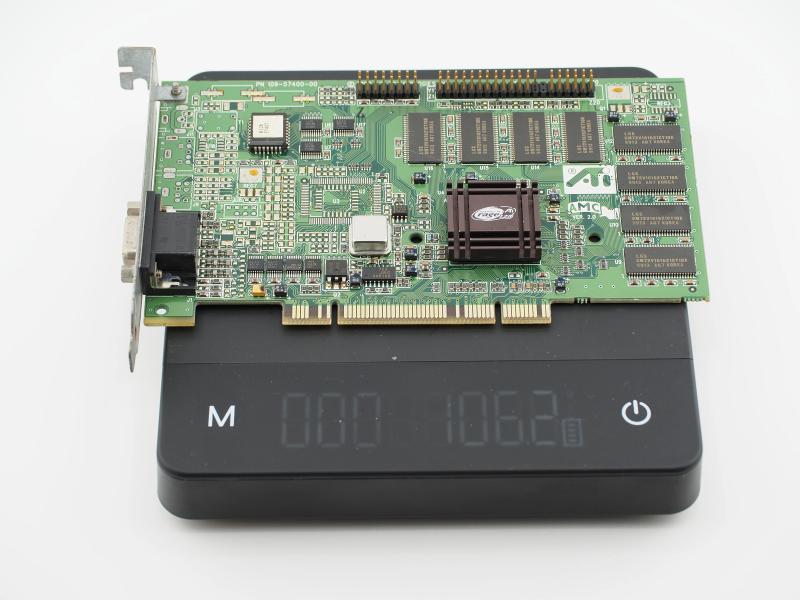
The passive cooler is a classic of the era, firmly glued down and stamped with the striking GRAPHICS BY rage128 logo. Analyzing the board up close under a macro lens reveals a pristine layout. The traces routing from the graphics chip to the memory array are a masterclass in period accurate 128-bit bus design. The memory chips themselves are immaculate, and the surface text is sharply legible:
PCB Silkscreen: PN 109-57400-00 (C) 1998 ATI TECHNOLOGIES INC.
Memory Chips: LGS GM72V161621CT10K 9913 AG7 KOREA
Primary Sticker: P/N 1025740700 000048
Secondary Sticker: TN920621FG3UA 630-2896
Compliance Marks: VERTEX M1 99 15 94V-0 E137137
Looking at the back of this board, you can see the heavy use of localized ground planes and a complete absence of rear mounted memory chips. The rear PCB is dominated by an enormous white silkscreen of the Rage 128 logo and a thick forest of through hole pins from the VGA connector and the top mounted AMC connector. The tactile feel of the sharp header pins and the slightly chalky paper stickers really anchors this artifact in its specific moment in computing history.
This artifact represents a massive leap in 3D acceleration architecture for ATI. The Rage 128 was built on a 0.25-micron fabrication process, packing approximately 8 million transistors. The chip under that brown heatsink is a Superscalar architecture featuring twin pixel pipelines. In an era where single-texturing was common, this allowed the chip to output two pixels per clock cycle.
The "128" in the name is not just marketing fluff. It refers to the true 128-bit memory architecture. Pushing data through this wide bus are eight discrete LGS (LG Semicon) Synchronous Graphics RAM (SGRAM) chips. The 10K in the part number indicates a 10 nanosecond access time, perfectly aligning with a 100 MHz theoretical ceiling, though these boards typically ran the memory synchronously with the core at 90 MHz.
One of the most highly touted features of this silicon was its hardware based DVD decoding. The architecture included a full inverse discrete cosine transform (iDCT) engine. This meant a sluggish Pentium II desktop could smoothly play a DVD without dropping frames, an extremely taxing workload for standard processors of the time. The top edge of the board houses the AMC VER. 2.0 (ATI Multimedia Channel) header, which allowed users to physically ribbon-cable this card to specialized TV tuner or video capture daughterboards.
The graphics card market in 1998 and 1999 was an absolute bloodbath. This specific silicon was thrust into a cage match against the 3dfx Voodoo3, the Nvidia RIVA TNT2, and the Matrox G400. ATI needed a heavy hitter, and the Rage 128 was their champion.
A fascinating piece of lore regarding this generation is the "32-bit color war." While 3dfx stubbornly stuck to 16-bit internal rendering, arguing that 32-bit was too much of a performance hit, ATI pushed hard into full 32-bit color depth. The Rage 128 was celebrated for maintaining incredibly high performance even when rendering in true color. However, the myth that ATI drivers were historically atrocious largely found its roots during this exact era. The hardware was universally praised by reviewers, but early adopters frequently battled OpenGL glitches and direct draw crashes until ATI finally stabilized their software stacks months after release.
It is always amusing to look back at the passive cooling on these cards. Today, a graphics chip pulling this much relative performance would require a triple slot vapor chamber. Here, we have a tiny piece of ridged aluminum, completely devoid of a fan, relying entirely on the ambient airflow of a beige ATX tower.
Identifying this exact board is a straightforward but satisfying forensic exercise. The board clearly identifies itself with the PN 109-57400-00 silkscreen. My research confirms this specific part number belongs to the ATI Rage 128 GL variant, specifically the 16 MB AGP model.
The date codes on the silicon provide a beautiful timeline of manufacturing. The LGS memory chips are stamped with 9913, meaning they rolled out of the Korean fabrication plant in the 13th week of 1999. The PCB itself bears a 99 15 mark near the vertex logo on the rear, indicating the bare board was produced in the 15th week of 1999. We can authoritatively conclude this exact card was assembled in China sometime in late April or early May of 1999. The presence of the AMC header and the 16 MB of SGRAM cements its status as a premium tier multimedia accelerator from the golden age of retro 3D gaming.