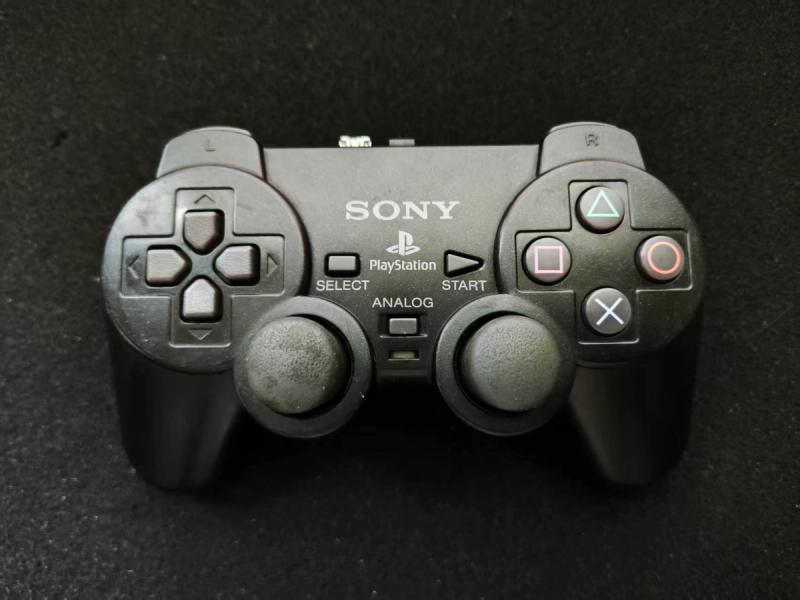

The owner of this item is a Chinese friend who has kindly provided the photos and information. Feel free to browse his 咸鱼 (Xianyu) platform for other oddities - you can do so by clicking on the profile under ‘Contributors’ section. Permission has been sought for the use of photos and writing of the article.
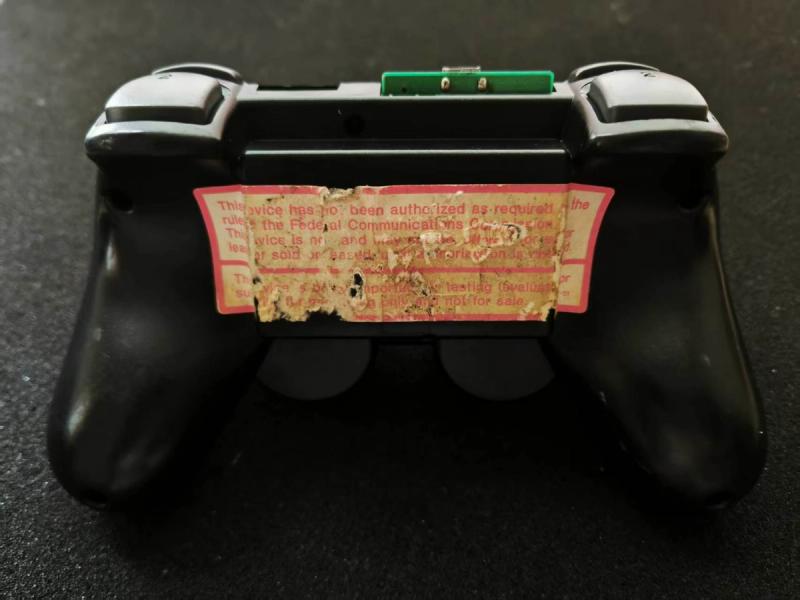
On its face, it looks like a standard, slightly worn PlayStation 2 DualShock controller. But flip it over, and you are greeted by a massive, unnatural plastic tumor grafted onto the back of the shell. It is a physical manifestation of an engineering team realizing, "We need to cram next-gen wireless hardware into a last-gen chassis right now." Opening the ABS plastic casing (clearly marked with M1-3-A injection mold tooling stamps) reveals exactly why that hump exists: a massive, pre-production lithium-ion battery. The custom label on the battery block reads Sample Cell Type: US323450A7T with a crucial date stamp of Release: 2006/3/2. Above this, on the top edge where a hardwired PS2 cable would normally exit, we see a totally custom I/O cluster: a Mini-USB port, what looks like a barrel power jack but is more likely a radio frequency port highly likely to be Bluetooth-related, and a recessed, unpopulated header of raw gold pins likely a Proprietary RF Debug interface used strictly for sniffing wireless signals during internal development.
The back of the controller tells an even more secretive story. It bears the tattered, pink remnants of a strict federal warning label: "This device has not been authorized as required by the rules of the Federal Communications Commission. This device is not, and may not be, offered for sale or lease, or sold or leased, until authorization is obtained. This device is being imported for testing evaluation or suitability for marketing only and not for sale.”
This specific artifact, kindly shared with our archives by a fellow collector and friend in China, is incredibly rare. It is not a standard developer kit controller that would have been mailed out to game studios. The crude, hand-modified shell and raw debug ports point to this being an internal Sony engineering mule, used strictly behind closed doors in Tokyo or San Mateo.
But the true historical weight of this artifact isn't in the plastic; it’s in the offset dual rumble motors housed inside the grips. To understand why this is a bombshell, we have to look at the massive corporate drama of 2006. Sony was embroiled in a brutal patent lawsuit with Immersion Corporation over force-feedback technology. Refusing to pay the licensing fees, Sony debuted the infamous "Boomerang" controller, and later the Sixaxis for the PS3, entirely stripping out vibration functionality. Sony executives famously went to the gaming press and arrogantly declared that rumble was a "last-generation feature" that was obsolete in the era of motion controls. It was a massive PR spin that gamers heavily criticized at the time. In late March 2006, Sony finally lost the lawsuit concerning vibration functionality. This means that three weeks prior to the lawsuit, Sony's hardware engineers were still actively working on developing a vibration- enabled controller. YouTube videos featuring prototype PS3 controllers did not feature vibration motors, indicating that time had passed after the lawsuit.
This prototype shatters that corporate narrative entirely. With a battery date-coded to March 2006, months before Sony’s E3 declarations, this artifact serves as undeniable, physical proof that Sony was secretly and actively developing a wireless, rumble-enabled PS3 controller the entire time. They never intended to abandon vibration; they were simply waiting out the legal battle while holding up a brave face to the public. It's a spectacular piece of physical evidence that proves what the community had always suspected: the "last-generation" speech was pure, unadulterated bluffing, entirely contradicted by the spinning, weighted DC motors sitting quietly inside this very piece of plastic.